The Game Boy Advance as a Laboratory for Familiar Ideas
A look at how the Game Boy Advance turned established series, racing, and shooter design into compact experiments with sharp identities.
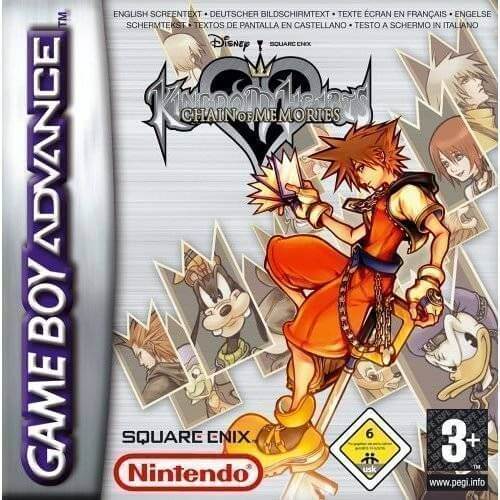
A handheld built for reinterpretation
The most interesting thing about Game Boy Advance is not that it hosted portable versions of larger ideas, but that it encouraged teams to rethink what those ideas could be when they had to fit a small screen, a limited control set, and short play sessions. In the best cases, the result was not a compromise. It was a redesign. Instead of shrinking console design until it fit, developers often stripped systems down to their essential rhythm and then rebuilt them around the strengths of handheld play: immediate readability, quick restarts, and a pace that let each stage or battle feel self-contained.
That is why the platform’s catalog can feel so varied even when the core genres are familiar. A deck-based action adventure like Kingdom Hearts: Chain of Memories is not trying to imitate a home-console action game beat for beat. It asks how exploration, combat, and progression change when cards govern both offense and defense. A top-down racer such as Karnaaj Rally takes a completely different route, transforming speed into a tournament economy of damage, cash, and upgrades. Even a straightforward shooter like Iridion 3D was pushed toward a distinct identity by the handheld format, where forward motion, obstruction, and enemy density had to be legible at a glance.
Seen this way, Game Boy Advance was less a miniature console than a test bed for reinterpretation. It rewarded games that could express their premise quickly and cleanly, because the handheld context made friction more obvious and repetition more important. A game that spent too long explaining itself risked losing momentum. A game that had one sharp twist, by contrast, could leave a stronger impression than a larger title with more surface complexity. The titles in this shortlist are useful precisely because they show that principle from several angles at once.
Combat systems that had to justify every input
The clearest example of handheld reinvention in this group is Kingdom Hearts: Chain of Memories. Its deck-building combat system gives every attack and defensive action a card value, turning movement through Castle Oblivion into a kind of strategic argument. That premise matters because it changes the feel of action itself. Rather than asking the player to memorize a long move list, the game makes each encounter a resource decision. Do you spend your better cards now, or hold them back for a more dangerous exchange later? On a system like Game Boy Advance, that clarity is powerful because it keeps battles readable even when the screen is busy.
The design also creates an unusual relationship between exploration and memory, which suits the story’s subject matter. Sora is searching for lost memories, and the game’s card system makes progression feel assembled rather than merely earned. Rooms are visited, reshaped, and revisited through cards, so the world becomes less a continuous landscape than a sequence of decisions about what should exist next. That fits handheld play especially well. A player can complete a room, stop, and return later without feeling that the game has lost its shape. The mechanics themselves encourage a modular relationship with time.
By contrast, Klonoa 2: Dream Champ Tournament uses a more immediate language. Its Wind Bullet creates a puzzle-platforming rhythm centered on capture, throw, and movement, meaning that action and traversal are inseparable. This is a different kind of elegance. Where Kingdom Hearts: Chain of Memories asks the player to think in terms of sequence and allocation, Klonoa 2: Dream Champ Tournament asks for spatial judgment and improvisation. Both approaches are distinctly handheld-friendly because they keep the player engaged with a single, crisp idea rather than a sprawling move set.
Racing and speed as portable spectacle
Racing on Game Boy Advance had a particular challenge: it needed to communicate velocity without the luxury of a wide, cinematic view. Karnaaj Rally answers that challenge by shifting the emphasis from visual spectacle alone to a violent tournament structure. Because the game is framed around earning cash, upgrading vehicles, and competing for the championship, speed becomes only part of the equation. Each run is not just about crossing the finish line first. It is about surviving contact, making smart upgrades, and staying invested in a broader competition that gives the races meaning beyond their immediate outcome.
That structure makes the game feel closer to a management loop than a pure arcade sprint, even though the moment-to-moment action is still about racing and combat. On a handheld, that kind of layering can be more satisfying than it might sound on paper. Short bursts of play work better when each burst contributes to a visible long-term goal. The player sees progress not only in lap times or victory screens, but also in the gradual improvement of the machine itself. The game’s tournament premise supports that sense of accumulation, which is important on a platform where sessions may be brief and interruptions common.
The same design logic appears in a more stripped-down way in Iridion 3D. Although it is a starfighter game rather than a racer, it is still fundamentally about forward motion through hostile environments, with rapid-fire weapons and obstacles shaping the player’s sense of speed. The important point is that both games translate motion into readable pressure. A handheld screen cannot rely on sheer scale to make velocity exciting, so it needs rules that make momentum feel consequential. Karnaaj Rally does that through vehicle combat and upgrades; Iridion 3D does it through relentless movement across planetary environments.
Shooters that turned limitation into identity
The two Game Boy Advance shooters in this shortlist, Iridion 3D and Iridion II, are useful because they show evolution without abandoning a recognizable core. Iridion 3D establishes the basic promise: pilot a spacecraft, blast through varied planetary environments, and survive waves of Iridion aliens and obstacles across multiple missions. That is a familiar shooter sentence, but its effectiveness lies in the combination of movement and clarity. In a genre that can become visually noisy, the need to read threats quickly becomes part of the tension. On a handheld, that pressure is not a flaw. It is the entire point.
Iridion II builds on that foundation by framing the action as a defense of planets across 15 diverse missions. The shift sounds subtle, but it matters. A shooter that presents itself as a sequence of missions has a more explicit sense of destination. Each stage feels like a discrete challenge with its own mood and purpose, rather than just another pass through an endless corridor of enemies. That structure helps the game feel purposeful on a portable device, where the player may want to finish a mission, pause, and later return to a fresh objective without re-entering a huge narrative or mechanical maze.
What these shooters reveal is that handheld design does not require simplification in the pejorative sense. It often means tightening the relationship between action, feedback, and progression. A mission-based structure, a visible enemy threat, and a consistent weapon rhythm can be enough if the game understands how to pace itself. Both Iridion 3D and Iridion II accept that the player is not looking for a simulation of flight. The player is looking for a clear challenge, one that can be understood instantly and mastered through repetition. That is a very handheld form of pleasure.
Familiar brands, altered purpose
The most revealing part of this shortlist is that some of its games come from major brands, yet they still feel shaped by the conditions of the hardware rather than by brand expectations alone. Kingdom Hearts: Chain of Memories is the obvious case, but Kingdom Hearts Re:coded shows the same pattern on Nintendo DS. It takes the idea of entering Jiminy Cricket’s journal, purging bugs, and restoring corrupted Data Worlds, then builds that premise around real-time action combat and a command system. The franchise identity remains intact, but the format shifts the emphasis toward concise, system-driven play that suits a portable machine.
That matters because it prevents the handheld entries from feeling like afterthoughts. When a famous series appears on a portable platform, there is always a risk that the game will be treated as a side project whose main job is to evoke the larger brand. The better approach, and the one these records suggest, is adaptation through focus. Kingdom Hearts: Chain of Memories does not merely transplant characters into a smaller box. It asks what emotional and mechanical themes are most legible when memory itself becomes a gameplay system. Kingdom Hearts Re:coded similarly makes the act of cleansing code-like corruption part of the premise rather than just the presentation.
This is also where handheld experimentation separates itself from nostalgia. A game can reference a larger series and still be doing something structurally new. The point is not to preserve every familiar element, but to decide which elements matter most when a player is likely to engage in shorter, more fragmented sessions. On Nintendo DS and Game Boy Advance alike, these design decisions are visible in the mechanics first. Story helps, but structure leads. That is why these games still matter when read as design objects rather than simply as franchise entries.
Why these games still read well together
Taken together, this shortlist suggests that portable design succeeds when it gives the player one strong reason to keep pushing forward. Kingdom Hearts: Chain of Memories does it through card-based combat and memory as structure. Karnaaj Rally does it through tournament progression and vehicle improvement. Iridion II and Iridion 3D do it through mission-based shooting that keeps each stage tightly legible. Klonoa 2: Dream Champ Tournament does it by making enemy capture and throw mechanics the center of both puzzle-solving and movement. Each one gives the player a compact rule set and then asks for commitment.
That is also why the group has a useful historical shape even though the genres differ. These are not just examples of random handheld ports or licensed curiosities. They are records of developers using constrained hardware to make focused design decisions. Some leaned into strategy. Some leaned into speed. Some leaned into spatial problem-solving. In every case, the result is a game whose identity is easy to state because its mechanics are doing real work. That is a quality worth valuing on Game Boy Advance, where the strongest experiences often came from systems that could be grasped quickly but kept paying off over repeated sessions.
The broader lesson is that portable platforms do not automatically produce smaller ideas. They often produce clearer ones. A game with a card combat system, a game with a combat-racing economy, and a pair of mission-driven shooters may not look related on the surface, yet they share a discipline of design that makes them feel of a piece. If there is a single throughline here, it is that handheld hardware rewarded intention. The games remembered from that era are often the ones that knew exactly what they wanted the player to do, then built everything around making that action memorable.