The Game Boy Advance as a Laboratory for RPGs, Platformers, and Remix Culture
A look at how the [[platform:gba|Game Boy Advance]] became a proving ground for original fantasy, compact action design, and later fan-made reinventions.
A Handheld Built For Reinvention
The Game Boy Advance mattered because it could absorb nearly any design idea and make it feel native to a handheld screen. It was small enough for quick sessions, but not so constrained that developers had to reduce every concept to the bare minimum. That balance made it a useful home for fantasy role-playing, precision platforming, arcade racing, and later a whole culture of reinterpretations that treated familiar worlds as raw material rather than fixed text. In that sense, the system was less a single genre machine than a portable test bed for how far established formulas could be pushed without losing their shape.
What stands out in this shortlist is not a single dominant style, but a pattern of adaptation. Magical Vacation and Lunar Legend use the handheld for long-form turn-based adventure, while Klonoa: Empire of Dreams translates a side-scrolling puzzle structure into a compact portable rhythm. Lady Sia and LEGO Racers 2 take different routes again, one leaning into swordplay and magical movement, the other into speed and track knowledge. Each game answers the same hardware question differently: how do you make a small machine feel like a complete world?
That question became even more interesting as the system's afterlife grew. The community-made entries in this shortlist show that the Game Boy Advance was not only a historical platform, but a continuing format for remix. Pokemon Let's Go Pikachu, Pokemon Let's Go Eevee, Pokemon Omniversal Emerald, and Pokemon Crippling Medical Debt Edition all use the language of the handheld to revisit a familiar structure through different lenses. That is the real throughline here: the GBA as a place where design ideas could be condensed, clarified, and then endlessly reframed.
Fantasy Systems That Reward Patience
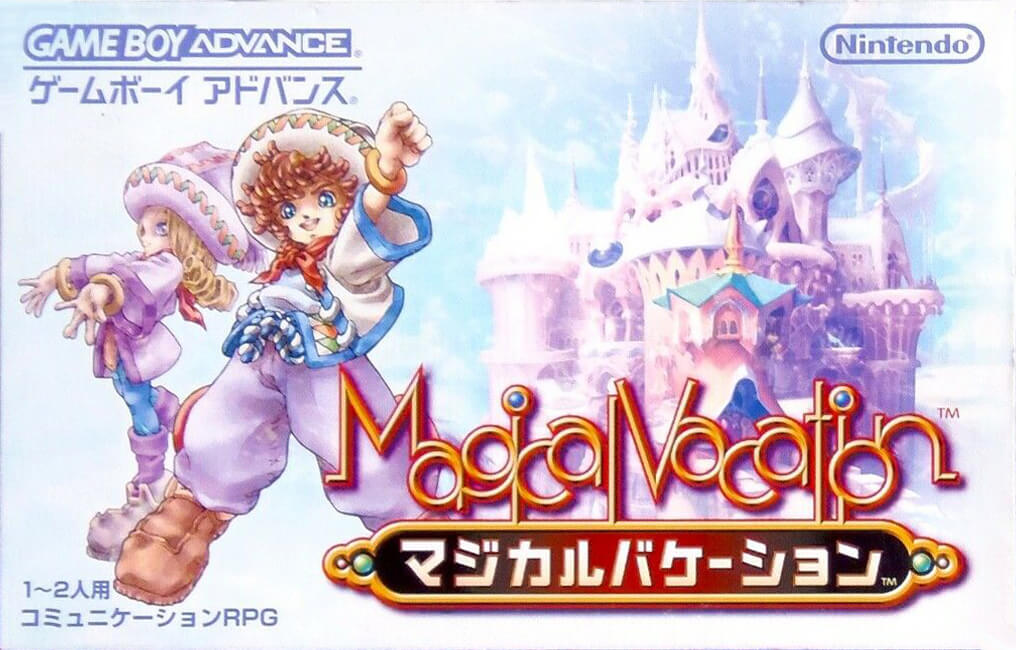
Among original role-playing games on the handheld, Magical Vacation is especially notable for the way it ties progression to a distinctive elemental spirit system. The premise is straightforward enough: students from a magical academy are sent across varied dimensions while searching for kidnapped classmates. But the structure turns that rescue quest into something more layered than a simple march from town to dungeon. Because the battle system is built around elemental interaction and progression, the player is not just improving statistics in the abstract; they are learning how the game's elemental logic changes the shape of every encounter.
That emphasis on system literacy places Magical Vacation in conversation with Lunar Legend, even though the two games approach fantasy from different directions. Lunar Legend follows Alex and his companions toward the Blue Dragon Cave in a classic turn-based quest shaped by the destiny of the Dragonmaster. The appeal there is not a complicated rules experiment, but the reliability of a familiar heroic arc. The game's strength lies in how clearly it frames movement through a mythic world: companions, destination, and destiny are all legible from the outset, which gives the adventure a steady forward pull.
Together, these two games show how portable RPGs on the Game Boy Advance could split into two useful traditions. One tradition leans into mechanical systems that ask the player to think in combinations and affinities. The other leans into narrative progression, where the pleasure comes from following a fantasy lineage through a world that is small enough to be grasped in short bursts, but coherent enough to support a full journey. Neither approach is superior. What matters is that the handheld could sustain both at once, often within the same library, without either one feeling out of place.
Action In Tight Spaces
If the RPGs on the system asked for long attention, the action-oriented games demanded immediate reading of space. Klonoa: Empire of Dreams is a good example of how a side-scrolling puzzle-platformer can be made to feel fresh without abandoning its basic ingredients. The game sends players through a series of stages where the Wind Bullet is used to grab enemies, chain double jumps, and solve environmental obstacles. That combination matters because it turns movement into problem-solving. Progress is not only about reaching the end of a stage, but about understanding how each enemy and platform arrangement can be folded into the next jump or route.
A similar attention to readable combat and traversal appears in Lady Sia, though the result is more openly confrontational. The heroine fights through varied environments using swordplay and magical powers while working to reclaim her kingdom from the Tuskals. That premise gives the game a strong linear motivation, but the important thing is how the action-platformer format lets that motivation stay tactile. A revenge quest can be abstract in a cutscene-heavy game; here, it is expressed through the act of pushing forward, cutting through resistance, and moving from one environment to the next with a sense of momentum.
Even LEGO Racers 2, which approaches the handheld from a racing angle, belongs in the same conversation because it treats track knowledge as a form of action literacy. Players race through LEGO-themed worlds, use power-ups, and search for shortcuts to beat Rocket Racer. The essential skill is not simply speed, but the ability to read the space quickly and convert that knowledge into an advantage. On the Game Boy Advance, that kind of design translated well because the screen size encouraged clarity. Games had to communicate their rules instantly, and these titles did so by making every move feel like a direct response to the stage in front of you.
Spin-Offs That Still Needed Identity
Some handheld projects are interesting precisely because they are not trying to be grand reinventions. Klonoa Heroes: The Legendary Star Medal takes control of Klonoa, Guntz, or Pango and sends them through varied stages in a top-down action RPG format. That shift in perspective changes the feel of the series without severing it from the broader identity of the characters. The aim is still to battle enemies, gather medals, and save the world, but the structure gives the game a different tempo from its side-scrolling cousin. It is a reminder that a spin-off can be more than a side story; it can be a way to test whether a character set can survive in another mechanical language.
That is part of why the Game Boy Advance became such a hospitable environment for familiar names. A known franchise could be reintroduced through a different genre, and the handheld audience would meet it on those terms. Klonoa: Empire of Dreams and Klonoa Heroes: The Legendary Star Medal are useful companions in that respect. One asks players to think about enemy manipulation and stage flow in a 2D puzzle structure; the other shifts toward top-down combat and progression through medals. Both keep the series recognizable while proving that a portable platform can support more than one interpretation of a character's appeal.
The same principle applies, in a different register, to Lady Sia. She is a character defined by action, but the game also gives her a mythic recovery story, one in which her journey through varied environments is inseparable from the goal of winning back her kingdom. On a handheld, that kind of clear identity matters. Players do not need sprawling exposition to understand why they are moving from stage to stage. They need a strong action grammar, a vivid premise, and enough variety in the obstacles to keep each level from feeling like a repetition of the last.
Remakes, Hacks, And The Long Life Of Familiar Worlds
The most revealing part of this shortlist may be the modern fan and community projects. Pokemon Let's Go Pikachu and Pokemon Let's Go Eevee both revisit the Kanto region through companion-focused journeys, with one centered on Pikachu and the other on Eevee. Their descriptions emphasize travel, catching, badges, and the climb toward the Pokemon Let's Go Pikachu path that players already know from the broader series. What matters here is not novelty for its own sake, but how these projects use the familiar GBA framework to make a classic route feel newly adjacent, as if a known map had been reentered from another door.
Pokemon Omniversal Emerald pushes that logic further by transforming Hoenn and asking the player to fill a special index of crossover creatures while using alien fusions and thoughtful battle tactics. That description signals a very different kind of fan creativity: not just retelling, but recombination. Pokemon Crippling Medical Debt Edition goes in yet another direction, framing the journey as the struggle of a bankrupt trainer trying to earn enough prize money to pay an enormous hospital bill. The tone is deliberately sharper, but the underlying structure is still recognizably GBA-style progression: gyms, battles, and a pressure to keep moving because the next fight matters financially as well as mechanically.
These projects demonstrate that the Game Boy Advance is no longer only a historical object. It is a template that still invites rewriting. The appeal of the system's original library was its clarity of form, and the appeal of the fan-made afterlife is that those forms remain easy to inhabit and alter. A region can be remixed, a companion can be recentered, a quest can be made satirical, and the underlying handheld logic still holds. That durability is the real legacy of the platform: it produced structures simple enough to remember, but flexible enough to be reimagined long after the original cartridges stopped being the only way to experience them.
Why These Games Still Read Well Together
Taken together, these games sketch a history of the Game Boy Advance as a system that rewarded contrast. Magical Vacation and Lunar Legend show two different ways to make turn-based fantasy feel worthwhile on a portable screen. Klonoa: Empire of Dreams, Klonoa Heroes: The Legendary Star Medal, Lady Sia, and LEGO Racers 2 show how the hardware could carry action, puzzle-solving, and speed without losing readability. The community projects then extend that same logic into the present, proving that the platform's design grammar remains useful even when the goals are playful, satirical, or deeply personal.
This is why the shortlist feels coherent despite its variety. The games are not unified by a single genre, developer, or even era. Brownie Brown, Game Arts, Attention to Detail, RFX Interactive, Namco, and Now Production each bring distinct priorities to the handheld, while Community Developer (ROM Hack / Fan Game / Mod) shows how later makers continue to treat the system as a living format. What unites them is that each title understands the value of concise systems and distinct identity. On a screen this size, clarity is not a compromise; it is the medium's strongest asset.
The GBA's best software therefore did more than fit into a portable shell. It used that shell to sharpen ideas until they became easy to read, hard to forget, and adaptable enough to survive beyond their first release window. That is the lesson these records suggest. Whether the game is a fantasy quest, a platforming puzzle, a race, or a fan-made retelling, the successful version is the one that makes its rules legible and its world compact without feeling thin. In that respect, the library remains a practical guide to game design, not just a catalog of nostalgia.