Game Boy Advance’s Quiet Robotics Boom: Strategy, Customization, and the Art of Portable Conflict
A look at how a small cluster of Game Boy Advance releases turned robots, tactics, and customization into a surprisingly varied portable subgenre.
A Portable Subgenre Built Around Machines
The Game Boy Advance was often celebrated for its platformers, role-playing games, and adaptations of bigger console brands, but its library also made room for a smaller and more specific fantasy: controlling machines. In a handful of releases, the platform offered everything from squad-level warfare to one-on-one robot duels, and even a ninja operative whose tools read like a stripped-down engineering kit. What connects these games is not just the presence of metal armor or futuristic hardware, but the way they ask players to think about machines as extensions of planning, identity, and timing.
That idea appears in different forms across Medabots Metabee, Medabots: Rokusho, Medabots AX: Rokusho Ver., Medabots AX: Metabee Ver., Mech Platoon, and Ninja Five-0. Some of these games center on strategic turn-based battles, some on real-time combat, and one on mission-based action with a grappling hook and katana. On paper that sounds like an assortment of unrelated curiosities, yet together they show how flexible the Game Boy Advance could be when designers treated robots not as a single genre promise but as a design language.
The result is a catalog slice that feels broader than its size. Natsume approached the Medabots material with a clear focus on custom robots and tournament progression, Kemco framed mechanized combat through territorial strategy, and Hudson Soft used a compact action setup to build tension around rescue missions. Even the community-made titles in the shortlist point toward the same fascination with familiar structures recast through machine-centered play. For a handheld system, that variety mattered: it let players sample different ideas about what a robot game could be without needing a giant hardware barrier or a long session commitment.
Medabots and the Pleasure of Building a Fighter
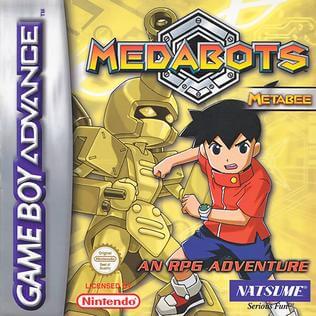
The clearest expression of machine personalization in this shortlist comes from the Medabots games. Medabots Metabee and Medabots: Rokusho are built around the fantasy of constructing, personalizing, and directing a robotic companion through strategic turn-based combat. Rather than presenting the robot as a fixed hero, these games make assembly part of the appeal. That shift is important: the player is not simply selecting a character class or equipping an item, but shaping a partner that changes how the battles unfold. In a portable format, that creates a neat loop of experimentation, because each fight can feed back into the desire to rework the machine before the next encounter.
The tournament framing also gives these games a clear sense of ascent. Both titles use a story structure that moves through rival battles and toward championship ambitions, which keeps the customization from feeling abstract. New parts are not just collectibles; they are tools for climbing a ladder. The fact that the games focus on progression through tournaments gives every design choice a visible consequence, whether that means preparing for a difficult opponent or tailoring a Medabot to exploit a specific weakness. This is the kind of structure handheld games handle especially well, because the player can make a small adjustment, test it in a battle, and immediately understand whether the machine is improving.
What is especially notable is how the two titles share a premise while still suggesting slightly different routes into the same world. The catalog descriptions emphasize squad or companion-based combat, rival encounters, and the hunt for better parts, which hints at an experience that rewards players who enjoy systems as much as story. In that sense, the Medabots games on Game Boy Advance stand as a practical example of how licensed material can be translated into a satisfying handheld strategy format. They turn a toyetic robot concept into something closer to tactical tinkering, and that is a surprisingly durable formula.
Two Ways to Fight in the Arena
If the turn-based Medabots games emphasize planning and patient customization, the pair of Medabots AX: Rokusho Ver. and Medabots AX: Metabee Ver. move the same world into a more immediate style of combat. The catalog describes them as 2D robot combat games and real-time fighting games respectively, with both centered on Robattles, squad customization, and tournament success. That shift matters because it changes the emotional texture of the Medabots concept. In the turn-based entries, the player is a strategist. In the AX games, the player becomes a combat operator who must keep up with the pace of the fight while still thinking about long-term team building.
The dual-version approach also suggests an emphasis on perspective and personality, even within a shared design space. By splitting the experience into Medabots AX: Rokusho Ver. and Medabots AX: Metabee Ver., the release strategy invites comparison and replayability without relying on a brand-new premise. The core loop remains recognizable: enter Robattles, upgrade the squad, and push toward the World Robattle Tournament. But the feel is different because real-time action demands more than menu decisions. The player has to respond, reposition, and attack in the moment, which can make the robot fantasy feel more direct and physical than a command-based battle system.
Together, the Medabots titles on the shortlist show how one franchise can support multiple interpretations on the same hardware. That is an important part of the Game Boy Advance story: it was a platform where developers could revisit a familiar universe and reframe it through different genres without losing clarity. Natsume did not treat Medabots as a single formula to be repeated; instead, the catalog suggests a willingness to use the brand as a testing ground for how much tactical depth, fighting-game energy, and tournament structure could coexist in portable form. For players, that meant the robots were not only customizable, but also surprisingly adaptable.
When Strategy Becomes Territory
Outside the Medabots line, Mech Platoon offers a different interpretation of mechanized conflict. The game puts players in command of mechanized infantry squads as they fight to capture territory and destroy enemy command centers, and its design depends on real-time resource management and careful tactical unit placement. That is a very different kind of machine fantasy from building a personalized robot fighter. Here, the machines are not individual characters with personalities implied by their parts; they are units in a larger operational system. The player’s attention shifts from tinkering with one body to orchestrating movement across a battlefield.
That broader battlefield perspective gives Mech Platoon a distinctly strategic identity. The mission is not just to win a duel or survive an arena bracket, but to make territorial gains while controlling the flow of resources. On a handheld screen, that kind of play creates a satisfying contrast between urgency and planning. Real-time action can be frantic, but real-time action with resource management asks the player to think ahead even while reacting. The placement of units matters, the timing of production matters, and the capture of territory matters because all of it supports the larger goal of breaking the enemy’s command structure. The machine theme thus becomes a matter of logistics as much as firepower.
Placed beside the Medabots games, Mech Platoon reminds us that “robot game” is not a genre so much as a starting point. The same aesthetic of mechanized force can support a character-driven tournament arc, a fighter-style battle system, or a command-level military puzzle. Kemco’s contribution in this shortlist broadens the picture by showing how the Game Boy Advance could carry games that were not merely action-heavy, but structurally ambitious in their own way. It is a useful corrective to any assumption that small-screen hardware only produced simplified strategy. Sometimes the simplification is only in the presentation; the thinking underneath can be very layered indeed.
Action, Rescue, and the Human Scale of Hardware
Not all machine-adjacent Game Boy Advance games in this shortlist are about building armies or customizing combatants. Ninja Five-0 approaches the platform from the angle of high-speed side-scrolling action, placing the player in the role of a ninja operative armed with a grappling hook and katana. The mission-based structure centers on battling terrorists and rescuing hostages across intense stages, which gives the game a different emotional register from the robot titles. Instead of claiming victory through parts, upgrades, or squad positioning, the player succeeds by mastering movement and close-quarters execution. Still, the game belongs in this discussion because its tools and pacing make the protagonist feel like a piece of specialized hardware in motion.
The grappling hook is especially telling. In a handheld action game, a tool like that does more than add utility; it defines the rhythm of play. It encourages the player to think about momentum, verticality, and recovery, while the katana gives each encounter a sharp endpoint. Those design choices echo the broader pattern seen elsewhere in the shortlist: the best portable machine fantasy is often one where the player learns to inhabit a system, not merely watch it operate. Here the system is not a robot body but an engineered set of movement options and mission constraints. The effect is still technological in spirit, even if the surface is more ninja than mecha.
This is also where the Game Boy Advance library’s range becomes clearest. A single platform could hold a game about rescue operations, and another about tournament robots, and another about territorial warfare, all while serving players who wanted concise, focused sessions. The common denominator is not genre in the narrow sense, but the promise that handheld play can distill a concept down to its most tactile parts. Hudson Soft used that promise to shape a fast, mission-based action game that feels distinct from the strategy titles around it, yet still part of the same larger conversation about precision and control.
Why This Cluster Still Feels Distinctive
What makes this shortlist interesting is not that every game shares the same mechanics, but that each one uses the Game Boy Advance to answer a different version of the same question: how should a player relate to a machine? In the Medabots games, the answer is through assembly and gradual refinement. In the AX titles, the answer becomes reaction speed and tournament performance. In Mech Platoon, it is command and resource allocation. In Ninja Five-0, it is agility under pressure, with tools that extend the body into space. That variety gives the catalog a coherence built on theme rather than formula.
The community-developed entries in the shortlist also underline how durable these ideas remain. Even when the exact premise shifts into fan-created territory, the attraction is still rooted in progression, map knowledge, battle tactics, and the pleasure of guiding a specialized protagonist through a familiar structure. That persistence suggests that the appeal of machine-driven play is not tied to one era or one publisher. It comes from the satisfaction of mastering systems that feel purposeful, whether those systems are competitive, military, or action-driven. The Game Boy Advance was a particularly good fit for that kind of design because it asked players to focus on readable, repeatable challenges.
Seen as a group, these titles illustrate a portable ecosystem where mechanical themes could be surprisingly expressive. The shortlist does not read like a museum of giant franchises or a roll call of blockbuster hits; it reads like a set of design experiments that happened to share a platform. That is precisely why it is worth revisiting. Small handheld games often gain their value not from scale, but from clarity. They show a single idea from several angles, and here that idea is the relationship between human choice and engineered force. Whether the player is customizing a Medabot, directing a mechanized squad, or leaping across a stage with a grappling hook, the underlying pleasure is the same: making a machine do exactly what it should, at exactly the right moment.